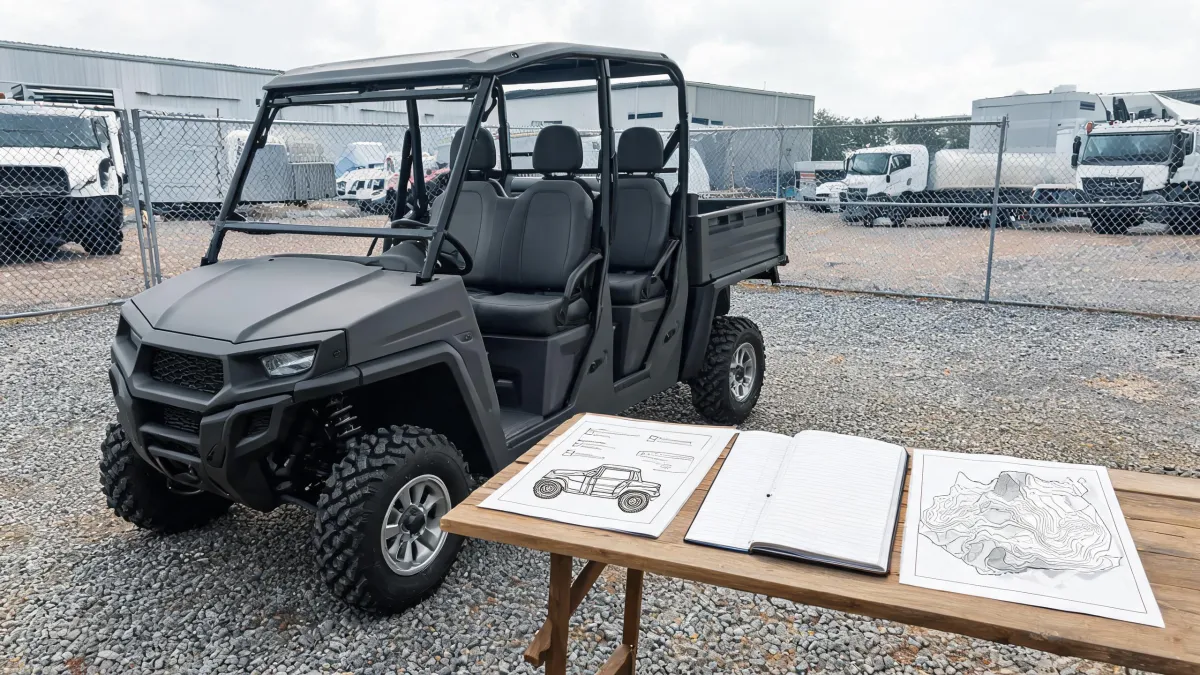
On a 2025 Polaris Ranger 1000 or Ranger Crew 1000, low gear is the range you should be running for most of the working day, and high gear is the conditional exception reserved for hard-packed surfaces with light loads. Turf mode is the second half of the answer, and the condition that flips it is this: it protects smooth, level ground, and it must come off before the machine meets a hill, a sidehill, or loose and slippery footing, where AWD is required. Both statements are bound to the owner manual written for this model, and neither carries over to another side-by-side without that machine's own book.
Why Low Gear Is the Ranger's Primary Range
Low gear is listed as the primary driving range for this machine, and high gear sits in a much narrower slot: hard-packed surfaces with light loads. That ordering is not a preference somebody at the factory happened to have. It follows from what a gear range physically does. Low range multiplies engine torque before it reaches the wheels, so the same engine output arrives at the tires with more force behind it, and that surplus is the margin that moves a loaded bed, drags a trailer, or pushes through grass and soft ground without lugging the engine.
The reason high gear exists at all, instead of being left off the vehicle, is that tall gearing asks very little of the driveline when the surface is firm and the bed is empty. On pavement or packed gravel with nothing aboard, the engine holds road speed at low effort, and the taller range keeps engine revolutions down for the same ground speed. The permission is narrow on purpose. The moment the surface softens or the load goes on, the condition that made high gear reasonable has already disappeared.
Which means the default answer to which range you should be in is low, and high gear is a decision you make against conditions you can see, hard-packed and lightly loaded, rather than a habit you slide into because the machine feels smoother at speed. For a fleet, that ordering changes how the machine is issued: low is the working setting a new operator is handed on day one, and high is the setting a supervisor asks about, because it is the one with conditions attached.
The Shift Sequence That Protects the Transmission
Changing range on this transmission is a stop-and-idle procedure, in that order. Stop the vehicle, let the engine drop to idle, then move the lever to the desired gear. Shifting with engine speed above idle, or while the vehicle is still rolling, is exactly what the manual tells you not to do.
The mechanical reason is that a gear change has to bring two sets of shafts inside the transmission to matching speed before the teeth can engage cleanly. A rolling vehicle keeps the output side turning, a revving engine keeps the input side turning, and the two are running at different rates, which means the engagement has to happen by force instead of by alignment. That is why the same requirement appears twice in the manual, once as procedure and once as a warning that damage to the transmission could result. Both versions say the vehicle stationary and the engine at idle before the lever moves.
For an operator, this is the least expensive discipline on the machine. A full stop costs a few seconds. A transmission does not, and the downtime lands on the same schedule as every other unit in the fleet.
What Turf Mode Does to the Rear Differential
Turf mode is engaged from the bottom of the switch, and what it changes is the rear differential. The differential is unlocked, the rear driver's wheel operates independently, and power is applied to only one wheel. The manual frames it as well suited to turf driving or to situations where active traction is not needed.
The physics behind the turf protection is easy to picture. In any turn, the inside rear tire and the outside rear tire travel different arcs, so the outer one has to cover more ground than the inner one. If the two are locked together, they cannot both follow their own arc, and the tire being asked to travel farther than its path allows has to scrub sideways across the surface to make up the difference. That scrub is what leaves marks and tears grass. Unlocking the differential lets each rear wheel follow its own arc, so the scrub disappears, and so does the share of drive force the locked pair used to pass between them.
Which means Turf mode is a surface-protection setting first and a driving mode second: it buys an unmarked lawn by routing drive to a single rear wheel.
Where Turf Mode Becomes the Wrong Choice
The line is drawn plainly. Operate in Turf mode only as needed, to protect smooth, level surfaces from tire damage, and do not operate in it when climbing or descending hills, when sidehilling, or on uneven, loose or slippery ground such as sand, gravel, ice, snow, obstacles and water crossings. On those surfaces, AWD is required.
That restriction follows from the same drive-force trade. Two driven rear wheels share the job of keeping the back end planted; with only one driven, the total force available before a tire breaks loose is smaller, and the wheel that still has power has nothing to fall back on once it loses grip. On a slope, gravity is already pulling the machine downhill. On gravel or ice, the surface is already giving less grip than the tire is asking for. Stack those conditions onto one driven wheel and the machine can slide where it was supposed to hold.
It comes down to which side of the trade the ground demands. A flat lawn asks for surface protection and gives away nothing in grip, so Turf mode is the right call there. A slope or a gravel lane asks for grip, and grip is the side you cannot hand over, which is why the AWD requirement reads as a rule rather than a preference.
Checks That Confirm Gear and Mode Are Set Right
The habit order that keeps all of this straight is short: stop, idle, shift, then pick the mode by looking at the ground ahead, and place the transmission in PARK when you step off.
Suppose a grounds crew is trimming the edge of a flat lawn and then crossing a gravel lane to the next property. On the lawn the switch sits in Turf mode, because the surface is smooth, level and does not need active traction. Before the front tires touch the gravel, the mode comes off and AWD goes on, because gravel is precisely the loose ground the Turf restriction names. The confirmation that it was done right is not a feeling. It is that the switch position matches the surface currently under the tires, not the surface the machine just left.
The two failures this order catches are predictable ones. The mode gets set once on the lawn and never revisited, so the machine arrives at the gravel lane still in Turf. The lever is where a slow roll can feel close enough to stopped, and the manual does not allow that reading: stationary means stationary, engine at idle. The check people skip when they are in a hurry is the last one — whenever the vehicle is left unattended, the transmission goes in PARK.
What Running Low Gear All Day Actually Costs
Low range is built to move load, and that capability is paid for at the pump and on the clock. At the same engine speed, low gear covers less ground; at the same ground speed, it turns the engine faster. A long loop in low therefore takes longer and burns more fuel than the same loop in high, and that is the bill for the load margin the range gives you. Nobody hands you that bill itemized.
The saving high gear offers is conditional, and it evaporates once the conditions change. Firm ground and an empty bed are the entire permission; soften the surface or load the bed and the fuel saving you were after is not on the table, which means the taller range would be doing a job it was not intended for.
Imagine a fleet running a long gravel loop with a loaded bed, and a supervisor asking why the machines are not in high gear to save fuel. The honest answer is that high gear is not the sanctioned range in that duty: gravel is not a hard-packed surface, and the bed is not lightly loaded. Shifting up to chase the number puts the strain back into the transmission and onto the maintenance budget, where it costs more than the fuel it was supposed to save. The fuel question becomes real only on the pavement run with an empty bed.
The objection that tends to arrive last concerns Turf mode: if it is gentler on the ground, why not leave it on all day? Because it drives one rear wheel, and the grip surrendered to protect the grass is the same grip needed the moment the ground tilts or loosens, which is exactly where it is forbidden. So the closing move is small and specific. Switch out of Turf mode before you leave the lawn, and put the transmission in PARK whenever you walk away from the machine.
