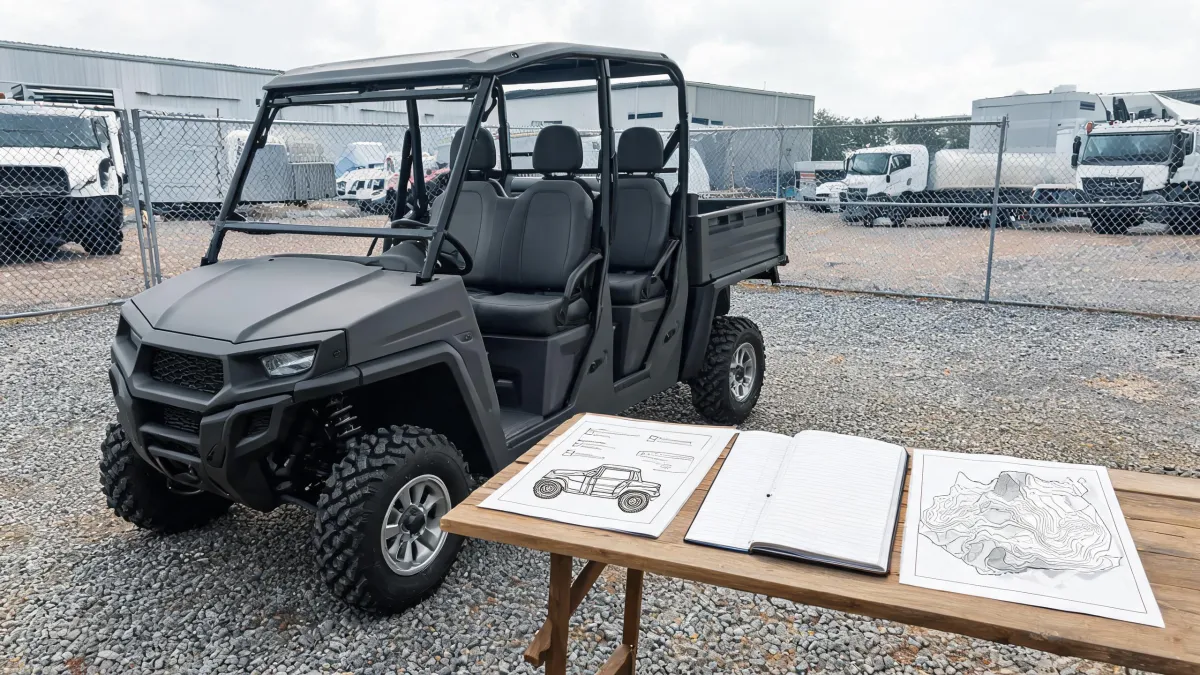
The short answer for a 2025 Polaris Ranger 1000 or Ranger Crew 1000 is to put the heavy part of the load low in the box, centered left to right, and biased toward the front wall, and to do that only after subtracting operator, passenger, accessories, and trailer tongue weight from the vehicle's maximum weight capacity. Placement inside the box is the second decision, not the first one.
That advice weakens in one specific case. If the load is light and bulky, such as empty totes or a stack of plastic drums that fills the bed and weighs almost nothing, keeping it contained and off the side rails matters far more than where it sits fore and aft, and nudging it a couple of inches forward buys nothing you can feel. Everything below stays tied to the Ranger 1000 and Ranger Crew 1000 and to the equipment actually bolted to the machine in front of you. A California reduced-capacity variant, or a unit running a different box, tire, or accessory set, does not inherit these conclusions automatically.
Set the Whole-Vehicle Load Budget First
The cargo box does not come with its own separate payload allowance. Weight counts against one combined ceiling: operator, passenger, accessories, rack or box contents, and trailer tongue load all add up, and that total must stay under the vehicle's maximum weight capacity. A box loaded to its visual limit can already exceed the vehicle limit once two adults, a winch, and a tongue load are counted, so there is no point fine-tuning the placement of a load that should not be on the machine.
Work the budget in this order. Read the maximum weight capacity for the exact model and version, using the decal on the machine itself rather than a remembered figure. Write down the operator and passenger weights. Add the accessories that stay bolted on: winch, bumper, roof, auxiliary battery, spare carrier, and the extra mass of larger tires and wheels. Add the trailer tongue load if you are towing. Subtract that total from the maximum, and the remainder is what the box and rack can carry. The order is deliberate because people and installed equipment are fixed for the trip, so subtracting them first leaves a cargo number you can still act on at the tailgate.
Confirm that number before you lift anything. Bagged feed, seed, cement, and most tool cases print a weight on the packaging, and a bathroom scale plus two trips handles a single heavy item that does not. If no scale is available, treat the remainder as a ceiling rather than a target and load visibly under it; a load comfortably beneath the limit and a load sitting on it look identical in the bed. Capacity varies across versions, so check the decal on the unit you are loading instead of assuming a fleet is uniform.
Put Mass Low and Forward in the Box
Inside the box, the heaviest items go as far forward and as low as possible, with the load centered on the vehicle. Low is easy to justify: the center of gravity of the whole machine is a weighted average of everything riding on it, so dropping mass closer to the floor lowers that average, which means less weight transfer when you brake, turn, or cross a side slope. Forward has a separate justification. Mass sitting behind the rear axle hangs on a lever, and the further back it rides, the more of its weight tries to rotate the front end upward; that is why a rear-heavy box steers vaguely and feels disconnected, and why the same load pushed against the front wall keeps the steering loaded.
The forward and centered instructions describe different axes. Centered concerns left and right, so both sides of the machine carry equal weight. Forward concerns the front-to-back axis. They only appear to argue when the box is partly full and the load is short, because pushing it forward puts it against the front wall, which is on the centerline by default. Nothing in the manual converts this into an inch measurement, and inventing one would be false precision; the check is whether the mass sits on the centerline and at the front of the box.
Given a choice between one dense block of weight and the same weight spread thin across the floor, take the dense block, provided the total stays inside the budget you worked out and the block sits fully within the box. A compact mass straps down in two directions and shows movement immediately, while a thin layer creeps under vibration, works into the corners, and hides that it has shifted. Loading forward puts the heavy pieces against the front wall, which is the least convenient part of the bed to reach.
Center Side to Side and Keep Load Inside
The lateral check takes seconds and needs no tools. Park on level ground, stand behind the machine, and sight down both side rails: the gaps between load and rail should match, and nothing should cross a rail or hang past the tailgate. Push the load sideways with one hand. Anything that rocks, rolls, or slides is not contained, and a load that moves under hand pressure will move under a pothole.
Overhang is the failure this check catches. Cargo extending past the side of the box puts its mass outboard of the box footprint, and the reason that is worse than the same weight carried inside comes down to lever arm: a tipping force acting on an outboard mass generates a larger moment than the same force acting near the centerline, so the machine leans further for the same push. Overhang also snags fences, brush, and door frames that the vehicle's own width already cleared.
Suppose two loads of identical total weight, one strapped centered and one with a steel toolbox clamped over the left rail. The weight budget cannot tell them apart. On a side slope or through a fast turn, the second asks more of the left tires than the right, and the driver reads it as a pull and a slower, vaguer correction. Offset and overhang are visible from behind the machine in a few seconds, which is why the look comes before any arithmetic at the tailgate.
Reduce Cargo and Speed on Rough Ground
Rough or hilly terrain changes the requirement rather than the load. The instruction is to reduce both speed and cargo to keep the machine stable, and the second half is the one owners skip, since slowing down while keeping a full box leaves the stability margin exactly where it was. The published speed caps are written for towing rather than for box cargo: 10 MPH on level grass with a load on the hitch, and 5 MPH while towing in rough terrain, while cornering, or while climbing and descending. Those figures do not transfer automatically to a loaded box, and there is no separate published speed table for one, so do not manufacture a number and call it the box limit.
The mechanism explains why the same load behaves differently on two surfaces. A static load in a box is just weight; the moment the ground turns rough, that load accelerates up and down, and the peak force pushed into the chassis and tires can exceed the weight itself. A hill adds a second effect, because gravity now has a component running along the slope, so part of the load's weight pulls sideways or front-to-back instead of straight down into the suspension. Both effects spend the same stability margin you were relying on during flat-ground cruise, which is why the response is a reduction in load or speed rather than more attention.
Picture the same box of tools crossing a flat field, then the same box on a side slope behind a barn. Identical weight, identical strapping, different job. The slope case deserves less load, lower speed, or another route, and nobody should be guessing at a tilt angle or inventing a threshold; the terrain itself tells you the margin is thinner than it was on the flat.
Keep People Out of the Cargo Box
No one rides in the cargo box, and the reason is stated plainly: a passenger there can fall from the vehicle or come into contact with moving components. That rules out the trick some owners reach for when a load feels unbalanced, sending a person into the bed to stand on the light side or shift weight by hand while the machine moves.
A person is a poor counterweight for three reasons that trace back to how the machine is built. Nothing in the box secures a human being the way straps secure a toolbox, so the person becomes the one part of the load that can move on its own. A person of ordinary weight also stands tall, and because the center of gravity is a weighted average of position and not just of mass, that height raises the combined center of gravity more than a dense crate of the same weight. The box itself sits outside the seating and restraint system the occupant protection was designed around, so a person there has none of it.
When the load needs a second set of eyes, the spotter stays on the ground. The driver stops the machine, the spotter walks to the tailgate and looks, and any adjustment happens with the vehicle parked. It costs a minute per stop and keeps the only person in the box from being the one thing nobody strapped down.
Shift to Low Gear and Brake Earlier
Two habits change when the box is heavy: gear selection and braking. Low gear is the recommended choice when hauling or towing heavy cargo, and the stated payoff is belt life. A belt-driven transmission holds its belt by clamping force, and low range keeps engine speed higher at the same slow travel, so the belt is less likely to slip under load.
Braking is where the extra mass announces itself. Heavy loads cause braking and control problems, and a loaded machine deserves real caution on the pedal. Extra mass means more energy must be shed to lose the same speed, so stopping distances grow, and under braking the weight transfers forward onto the front tires and off the rear. It comes down to margin: squeeze earlier and progressively instead of late and hard, and leave the gap ahead that a lighter machine would not need.
Downhill is the case that punishes optimism. A loaded machine on a grade has gravity working with the load rather than against it, and terrain that may force you to back down a slope to get out is exactly the situation the manual says to avoid. If reaching a spot means that might be the exit, the useful decision happens before you commit: choose a different approach, split the load, or leave it, rather than discovering the problem where the machine is already deciding for you.
The tradeoff is simple to state and hard to live with. Low, centered, forward loading buys a lower center of gravity and more stability margin under the combined weight limit, and it charges you easy access to the front of the box, a load that sometimes has to be built in an awkward shape to stay against the wall, and an extra minute at every stop. When quick access is the real requirement, reduce the load or change the box setup; do not slide mass rearward to where your hands can reach it.
